Introduction
Few monuments in India seem to possess the magnitude, symbolism, and artistry to match this magnificent Sun Temple. The Konark, as it is properly known as the Konark Sun Temple, was built during the 13th century with the idea of it becoming a massive stone chariot for Sun God Surya; pulled by the 7 magnificent stone horses and mounted with 24 giant wheels each measuring 10 ft in diameter, this structure is a remarkable feat of engineering so grand it remains one of India's most famous UNESCO World Heritage Sites even after almost 800 years.
In this blog we will cover the narrative behind the architecture, exactly what one should look out for when visiting the site, and how the Konark fits into an itinerary covering Odisha, from Bhubaneswar through to Puri.
Story of Konark
The story behind Konark: Back in the 13th century, Eastern Ganga ruler king Narasimhadeva-I commissioned the Konark Sun Temple to be built in the shape of an enormous chariot that would carry the Sun God across the sky. As history suggests, the tall main tower of this grand temple once stretched further to the sky than what can be seen today, although the actual height has been a point of debate amongst historians, and the centre sanction tower has crumbled down Centuries ago.
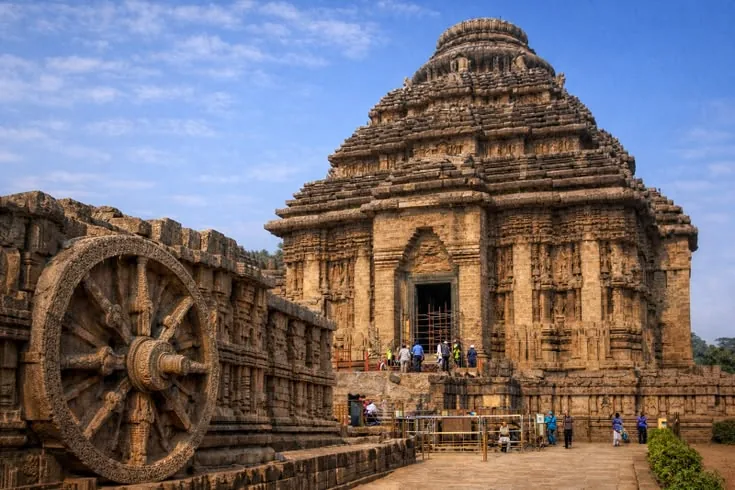
Of what remained, which are the audience hall “Jagamohana,” which are laced with finest depictions, is part of this wonder - The temple is actually a chariot with 24 Wheels, each measuring about 10 feet in diameter with the wheels etched out with finest Spokes detailing them!
Wheels at Konark- Sun, Moon & Time!
That is another astounding part of this entire structure! The 24 stone wheels that are there in this structure do not only work as an artistic feature of the Konark Temple but also serve the purpose of telling time as a huge Sun Dial! The eight spoked wheels here throw shadows with uncanny precision. Now can you find any monument across the world that has made it possible to document time with such architectural brilliance and finesse with it is beyond human comprehension.
Why is Konark known as India's Stone Chariot
The architecture, in broad terms, mimics the Sun God’s Chariot with the 7 horses on which it is perched signifying the 7 days of the week, and also rests on the 24 spokes, signifying the 24 hours of a day which is equally divided into two sets of 12.
This intentional cosmological symbolism captured in stone, on such an epic scale is why the Konark is widely considered one of the most ostentatious creations of Indian Temple architecture and beckons people for religious visits and architecture lovers alike
What to See at Konark Today
Jagamohana (audience hall) - the best-preserved major structure, covered in detailed relief carvings depicting deities, dancers, and everyday life.
24 stone wheels - best examined up close for their carved spokes and sundial detailing.
Surviving stone horses - positioned at the temple's entrance, representing the chariot's team.
Archaeological Survey of India museum nearby - housing sculptures and fragments recovered from the site, useful for context before or after the temple visit.
Most visitors spend 2-3 hours at Konark to properly take in the scale of the carvings without rushing.
Konark when on the Odisha tour
Konark does not make much sense if it is visited by itself. Almost all the time Konark forms a part of a round trip to Puri for it does not take that long to drive between the two places. Bayard Vacations use this exact model to include the day trip for Konark in our Odisha tour package.
In the 3 Nights 4 Days Golden Triangle package starting from as low as Rs.16500 per person only, the whole day for Day 2 is set aside for a day tour from Puri to Konark and back.
A day tour, there is no change in the itinerary for Konark Day Tour when traveling for Longer tours of 5 Nights 6 Days and 6 Nights 7 days packages for longer journeys simply cover some other popular tourist destinations like Gopalpur on sea, Chilka Lake and Bhitarkanika on to of the Golden Triangle trip itinerary.
Best Time to Visit Konark Sun Temple
The best time to visit Konark would be from October to February, as most of the site requires walking outdoors across a vast open stone complex with very little shade. Visiting during the summer months (April-June) may make a multi-hour visit much more tiring due to the heat reflecting off of the temple's stone surfaces.
Practical Tips for Visiting Konark
Arrive earlier in the day to avoid both the midday heat and peak tourist crowds.
Hire a local guide at the site, since much of the carving's symbolism isn't immediately obvious without context.
Carry water and sun protection, as most of the site is uncovered.
Combine the visit with Puri's Chandrabhaga Beach, a short distance from Konark, for a relaxed close to the day.
Bayard Vacations Odisha Packages Featuring Konark
Every one of our core Odisha itineraries includes a full day dedicated to Konark:
Bhubaneswar & Puri (3N/4D) - starting from ₹16,500 per person, our compact Golden Triangle circuit with a dedicated Konark day trip.
Religious Tour of Bhubaneswar, Puri & Gopalpur (5N/6D) - starting from ₹28,000 per person, extending the same Konark visit further to Chilika Lake.
Odisha with Bhitarkanika (6N/7D) - starting from ₹31,000 per person, adding the Buddhist circuit and Bhitarkanika wildlife sanctuary to the same core route.
Conclusion
A monument of ingenuity Konark isn't simply a monument; it's a truly ambitious effort of engineering and symbolism built, in stone, on a level unmatched anywhere else. A short, central element to your Odisha journey, or perhaps a side-stop on a longer tour focused on ancient Indian temples,Konark is a visit well worth the unrushed, casual time needed to take in each carved wheel, each painted steed, each stonehall. The time is well spent.
Thinking About Konark or other Odisha experiences?
Bayard Vacations builds Odisha itineraries, centered on the temples of Bhubaneswar, the pilgrim holy sites of Puri, and the grandeur of Konark, with opportunities to venture further to the saline marshes of Chilika or the crocodile sanctuaries of Bhitarkanika.
FAQs
1. Why is the Konark Sun Temple called India's Stone Chariot?
The temple is designed as a giant chariot carrying the Sun God, Surya, across the sky — complete with 24 carved stone wheels and 7 horses, symbolizing the days of the week and the hours of the day.
2. Do the Konark Sun Temple's wheels actually tell time?
Yes. Each of the 24 wheels is divided by eight spokes, and the shadows they cast are believed to indicate time with remarkable precision, functioning as a giant stone sundial.
3. How much time should I spend at Konark Sun Temple?
2 to 3 hours is generally enough to explore the Jagamohana, the wheels, and the surrounding carvings without rushing.
4. Can Konark be visited as a day trip from Puri?
Yes. Konark is almost always visited as part of a round trip from Puri, given the short driving distance, and this is exactly how it's structured across Bayard Vacations' Odisha packages.
5. What is the best time to visit the Konark Sun Temple?
October to February offers the most comfortable weather, since the site involves significant outdoor walking across an open stone complex with limited shade.
Explore Odisha Packages
Start Your Adventure
Our travel experts are ready to plan your next dream vacation.
No spam, only pure inspiration.